Is it safe to travel to Egypt on an organized tour?
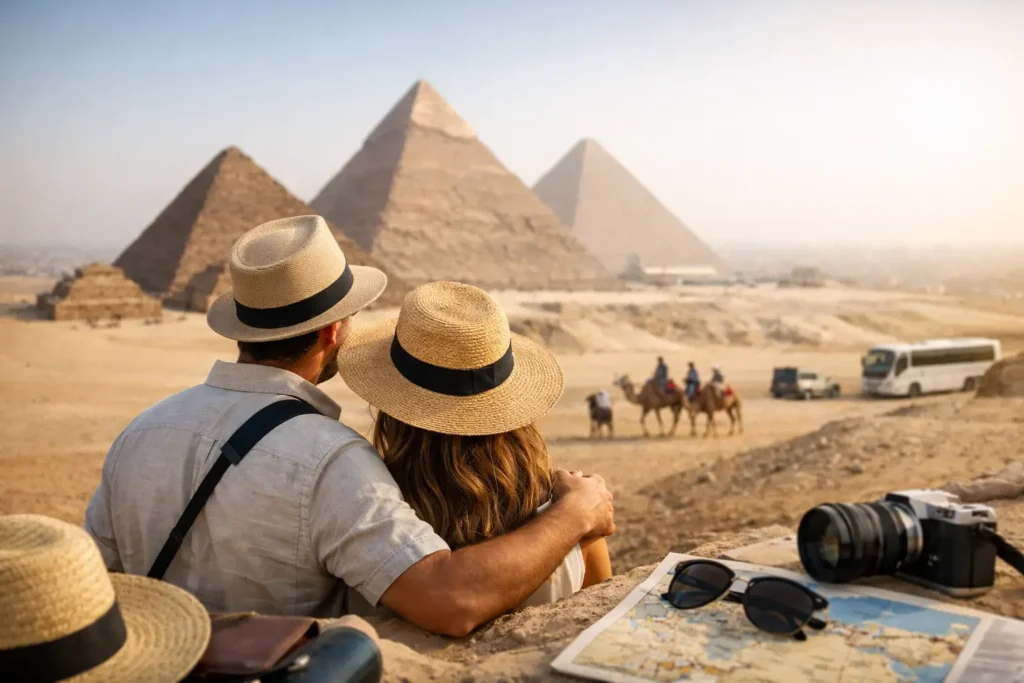
The doubt appears long before packing your suitcase. It appears when you start looking at routes through Cairo, Luxor or Aswan and you wonder if it is safe to travel to Egypt on an organized tour or if the perception of insecurity outweighs the reality of the destination. The short answer is yes, it can be a safe, comfortable, and highly enjoyable trip, but it depends heavily on how it is planned, who you travel with, and the level of local support behind it.
Egypt is not a destination for wild improvisation if you are looking for peace of mind. Nor is it that impossible place that is sometimes painted from the outside. It is a country with a highly developed tourist infrastructure in its most visited areas, with well-established cultural tours and local professionals accustomed to receiving international travelers. When the trip is well organized, with resolved transfers, verified accommodations, and reliable support, the experience changes completely.
Is it safe to take an organized tour to Egypt today?
Yes, on most standard tourist itineraries, taking an organized tour to Egypt is a safe option and, for many people, the most sensible one. Not because Egypt is a dangerous destination by definition, but because it has particularities that are better not managed on the fly: long distances, intense changes of pace, chaotic traffic in some cities, cultural differences, and a local operation that works much better when it is already coordinated.
The most common routes – Cairo, Luxor, Aswan, Abu Simbel, and the Red Sea – receive travelers all year round. In these areas, there is a constant tourist presence, checkpoints at key access routes, and a network of guides, drivers, and accommodations who know the visitor’s needs well. That doesn’t eliminate all risks, of course, but it does reduce many of the most common problems.
The important nuance lies in the type of organization. Not all organized trips offer the same security. There is a clear difference between a mass tour, with tight schedules and providers chosen by price, and a well-designed itinerary, with trusted local partners, personal attention, and real margin to travel unhurriedly. That is where a trip stops being just comfortable and starts being more responsible too.
What really worries the traveler
When someone asks about safety, they almost never talk only about crime. They talk about whether they will feel lost, whether they will be able to move around without tension, whether the environment will be overwhelming, or whether they will have someone to call if something does not go as expected. In Egypt, those questions are reasonable.
On the one hand, there is general safety at the destination. In the main tourist areas, the traveler usually encounters a fairly controlled context. On the other hand, there is practical safety, which often carries more weight on a day-to-day basis: avoiding unnecessary travel, not having to negotiate every journey, knowing that the accommodation is well located, and having local people who will respond if there is a change of plan.
It is also worth talking about something less dramatic but much more frequent: fatigue. Egypt can be intense. Early mornings to visit temples, heat, bustling cities, and long journeys mean that a poorly put-together trip ends up generating stress. Good organization reduces that wear and tear. And that is also safety.
Why an organized trip provides more peace of mind
The main advantage is not just having the reservations made. It is having a structure designed so that the trip flows. When you land in a new country and you know who is picking you up, where you are sleeping, how you are moving between cities, and who is assisting you if anything unexpected arises, the level of calm changes immensely.
In Egypt, this is especially noticeable in transfers. Moving from an airport to a hotel, connecting a cruise with a visit, or moving between cities without relying on last-minute decisions makes all the difference. The same goes for cultural visits. A good guide doesn’t just explain monuments. They also orient, contextualize, and help to better read the environment.
Furthermore, traveling organized allows you to better filter the real quality of the service. It is not about chaining hotels and excursions without criteria, but about selecting providers that work well, respect the traveler, and work with clear standards. When there is prior review and direct dealing with local teams, unpleasant surprises are minimized.
The real risks, without the drama
Saying that Egypt can be safe does not mean selling a perfect postcard. There are aspects that should be taken into account and that an informed traveler should evaluate before booking.
The first is the political and social context, which can change and requires reviewing up-to-date recommendations before leaving. The second is the daily health of the trip: hydration, heat, food, and pace. Many problems in Egypt have nothing to do with public safety, but with not adapting well to the climate or wanting to see everything too quickly.
There is also the issue of commercial harassment in some tourist areas. For some people it is a simple annoyance; for others, it is exhausting. Going with professional accompaniment or with pre-organized visits helps a lot to reduce that feeling of constant pressure. It doesn’t completely disappear everywhere, but it is managed much better.
And then there is the driving and traffic, especially in large cities. Anyone who has traveled independently in similar destinations knows that not everything is worth solving on your own. Sometimes, delegating logistics is not an extra luxury. It is a very practical decision.
How to know if an organized trip to Egypt is well planned
The useful question is not only whether it is safe to travel to Egypt on an organized tour, but what signs indicate that the trip is truly well designed. One of the clearest is that they don’t promise you’ll see half the country in a few days. Rushed itineraries usually multiply fatigue, logistical errors, and the feeling of always playing catch-up.
Another positive sign is direct collaboration with reliable local suppliers. We are not talking about impersonal brokering, but about working with teams who know the terrain, respond quickly, and have been tested in real situations. That provides much more confidence than a closed booking with no context.
It also helps if the proposal is clear about what is included, travel times, and the type of accompaniment. If everything sounds too good to be true but no one explains how transfers are handled, who assists you there, or what the margin is for incidents, you should be suspicious.
In a responsible trip, moreover, safety is not separated from the way of traveling. Choosing well-managed accommodations, avoiding unnecessary hotel changes, and relying on serious local partners not only improves the experience. It also reduces friction and makes the trip more sustainable in a broad sense.
Safety and sustainability are not separate
Sometimes responsible travel is presented as if it implies giving up comfort or support. In our experience, quite the opposite is true. A well-designed sustainable trip usually opts for more human paces, more stable stays, and a more direct relationship with the people who make the route possible. All of that adds safety.
Sleeping at least two nights per stop, for example, is not just a more conscious way to travel. It also allows you to orient yourself better, rest, and not live every day like a race. Working with trusted local agencies in Egypt improves operational control and fosters a more positive impact at the destination. And having a human contact before, during, and after the trip reduces a lot of uncertainty.
That is especially valuable for couples, families, corporate groups, or educational centers, where safety does not depend on an adventurous person solving things on the fly, but on serious planning and a solid local network.
So, who is it worth it for?
If Egypt appeals to you but you don’t feel like negotiating every transfer, improvising schedules, or managing incidents in an unknown context, an organized trip makes a lot of sense. Also if you value traveling calmly, understanding what you see better, and feeling that there is someone behind the scenes truly responding.
It does not mean giving up authenticity. In fact, a good organized itinerary can bring you closer to the destination than an improvised and exhausting trip. The key is to flee from the impersonal circuit and look for a proposal designed with good judgment, human attention, and reliable local partners. That is the approach we take at EcoJourney Spain when we design cultural routes with vetted providers and real accompaniment.
Egypt continues to command respect, and that is normal. But respect is one thing, and fear is another. When the trip is well built, with reasonable times and reliable local support, the country opens up in a much friendlier way. And then the question stops being whether you dare to go, and becomes how you want to experience it.